Wire Gauge Chart (AWG)
American Wire Gauge sizes with approximate solid-copper diameter. Use this table to read a stamp or convert a label — not to design a house circuit. Common branch questions live on the ampacity chart and the AWG tool.
Reference only. Confirm AWG on the product, temperature rating, and local code. Not a substitute for a licensed electrician. Disclaimer
| AWG | Diameter (in) | Diameter (mm) | Common association (shop) |
|---|---|---|---|
| 4/0 AWG | 0.4600 | 11.684 | Service entrance / large feeder conductor |
| 3/0 AWG | 0.4096 | 10.404 | Service entrance / large feeder |
| 2/0 AWG | 0.3648 | 9.266 | Service entrance / large feeder |
| 1/0 AWG | 0.3249 | 8.252 | Sub-panel feeder / large load |
| 1 AWG | 0.2893 | 7.348 | Sub-panel feeder / large load (conditions apply) |
| 2 AWG | 0.2576 | 6.544 | Large feeder (conditions apply) |
| 3 AWG | 0.2294 | 5.827 | Large feeder (conditions apply) |
| 4 AWG | 0.2043 | 5.189 | Feeder / high-load circuit (conditions apply) |
| 6 AWG | 0.1620 | 4.115 | Higher capacity runs (conditions apply) |
| 8 AWG | 0.1285 | 3.264 | Larger feeders / higher load (conditions apply) |
| 10 AWG | 0.1019 | 2.588 | Often associated with 30A copper (conditions apply) |
| 12 AWG | 0.0808 | 2.053 | Often associated with 20A copper branch (conditions apply) |
| 14 AWG | 0.0641 | 1.628 | Often associated with 15A copper branch (conditions apply) |
| 16 AWG | 0.0508 | 1.291 | Light duty extension / low current — no NEC ampacity rating |
| 18 AWG | 0.0403 | 1.024 | Low-current / lamp cord class — no NEC ampacity rating |
| 20 AWG | 0.0320 | 0.812 | Signal / electronics wire — no NEC ampacity rating |
Sample-length copper (12 AWG)
Not whole-house cable. One short-length 12 AWG option for shop experiments — confirm AWG on the listing. Permanent wiring still needs code and a qualified electrician.
As an Amazon Associate we earn from qualifying purchases. Disclosure
How to read this chart
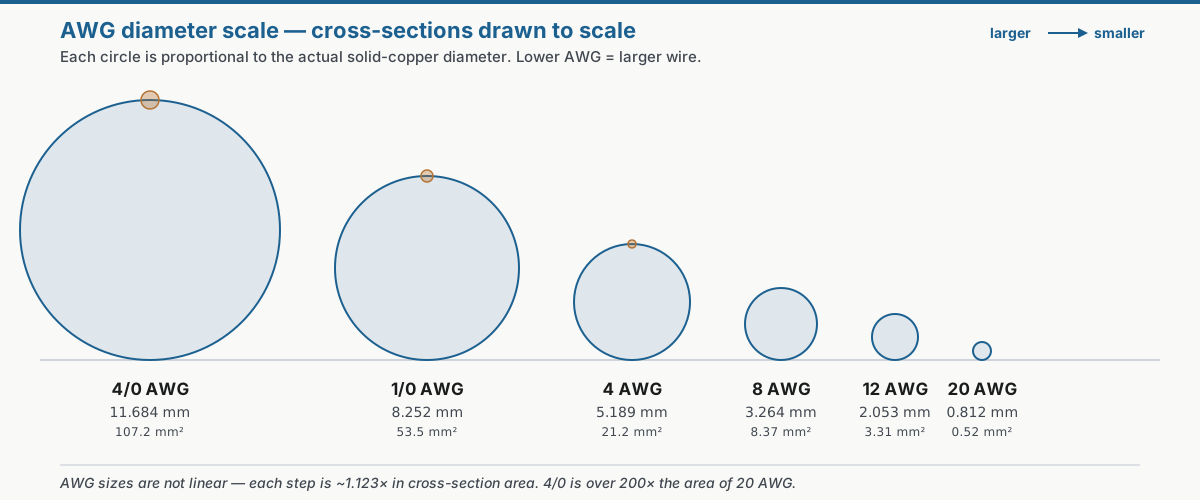
AWG numbering runs backwards from what you might expect: a lower gauge number means a thicker wire. 4/0 AWG at the top of the table is 0.4600 inches across — nearly half an inch of solid copper. By the time you reach 20 AWG at the bottom, the diameter is only 0.0320 inches, thinner than a sewing pin. Resistance depends on cross-section area, so thicker gauges carry more current with less voltage drop.
This table lists solid-copper dimensions. Stranded wire of the same AWG has the same total copper area but a slightly larger overall diameter because of gaps between strands. For a focused current question — such as “what gauge for a 20 amp branch?” — open the 20 amp guide or the ampacity lookup tool. Temporary cord runs are a different job — use the extension cord gauge helper.
Sizes without NEC ampacity
AWG 16, 18, and 20 appear with diameter but no NEC branch-circuit ampacity on this site’s reference. These are signal, lamp-cord, and electronics classes — NEC Table 310.16 does not list a current rating for them in residential power contexts. The aught sizes (4/0, 3/0, 2/0, 1/0) are pronounced “four-aught,” “three-aught,” and so on; they are service-entrance and large feeder conductors, not branch-circuit wire.
This chart covers copper only. Aluminum and copper-clad aluminum conductors have different ampacity values and termination rules — they are out of scope here. For a broader comparison across insulation types and installation methods, see the ampacity chart.
FAQ
What is AWG?
American Wire Gauge. Larger numbers are thinner wire (18 AWG is thinner than 12 AWG). Diameter columns on this chart are approximate solid-copper values for workshop comparison.
Is this chart a substitute for electrical code?
No. It is an educational size reference for home-shop questions. Branch-circuit design, temperature ratings, conduit fill, and terminations require the local electrical code and a qualified electrician when the job is not a temporary cord-style question.
How do I use this chart with the AWG tool?
Scan the AWG column for the stamp on the wire or the size in your question, then open the AWG / ampacity tool to walk a scene (15A / 20A / 30A-class) or pick a gauge with a short condition note.
Why do some AWG sizes look thicker than I expected?
This table shows approximate bare conductor diameter, not insulation outer diameter. Jacket type and stranding change the overall cord size.
What does AWG stand for in wire sizes?
AWG stands for American Wire Gauge, a standard sizing system for round solid electrical conductors dating to 1857. Lower AWG numbers mean thicker wire; higher numbers mean thinner wire. The system is defined by ASTM B258-18, which fixes the diameter for every size from 4/0 (0.4600 in) down to 20 AWG (0.0320 in).
Does a lower AWG number mean thicker or thinner wire?
Lower AWG means thicker wire. 4/0 AWG has a diameter of 0.4600 inches (11.684 mm); 20 AWG has a diameter of 0.0320 inches (0.812 mm). The numbering comes from the number of drawing passes used in the original 19th-century wire mill — more passes produced thinner wire, so higher gauge numbers correspond to smaller cross-sections.
What AWG do I need for a 20-amp circuit?
For a 20-amp copper branch circuit, 12 AWG is the common residential size — the ampacity chart lists 12 AWG at 20 A in the 60 °C column. That association assumes copper conductors, the listed insulation rating, and standard installation conditions; it is not universal. For the full decision (including when 10 AWG is required for voltage drop or continuous loads), see the dedicated page on gauge selection for 20-amp circuits.
Sources
Diameters follow ASTM B258-18 nominal values for solid round copper conductors. Ampacity associations on this site are simplified and are not a code table; for installed circuit design, see NFPA 70 NEC Table 310.16 (latest edition adopted by your jurisdiction).
- ASTM B258-18 — Standard Nominal Diameters and Cross-Sectional Areas of AWG Sizes
- NFPA 70 NEC 2023, Table 310.16 — Allowable Ampacities of Insulated Conductors (Copper)
- Wikipedia — American wire gauge
- Engineering Toolbox — AWG wire gauges
See the site disclaimer for limits of use.