Reference family
Cutting
Cutting reference charts and tools for the home workshop — hole-saw sizes, finder, and the third leaf when it ships.
Start here
Look up a hole-saw size for a common DIY job, or open the finder to convert a diameter. The third Cutting page ships later.
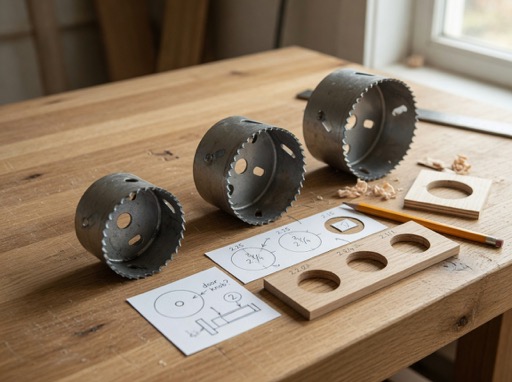
Hole saw size chart
18 common hole-saw diameters in inch and exact mm, with arbor and material fit.
Open chart → Hole saw size finder
Pick a job (door lock, recessed light, pipe) or a diameter → saw label.
Open finder → Router bit types chart
18 common DIY router-bit profiles with shank size, bearing type, collet requirement, and typical cut.
Open chart →Browse by topic
Published Cutting charts and tools — catalog-driven, new pages appear here when registered.
Flagship chart
Hole saw size chart
18 common hole-saw diameters in inch and exact mm, with arbor and material fit for typical DIY jobs.
How it works
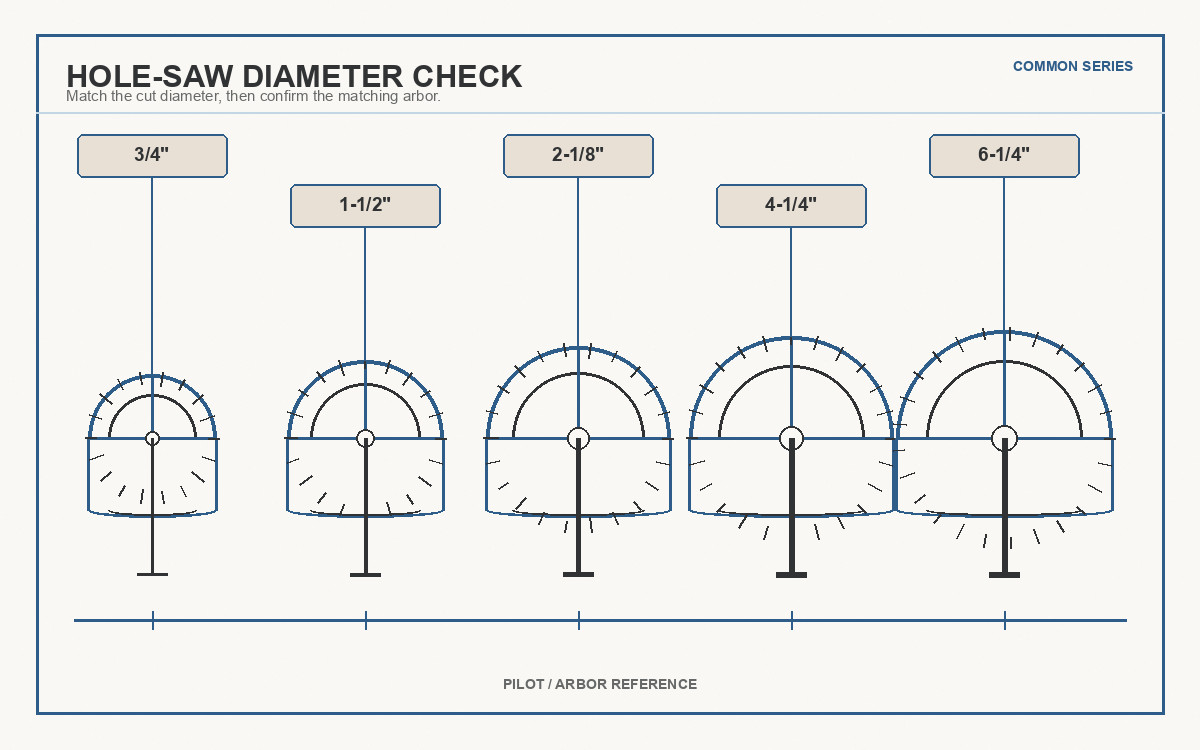
Look up the diameter, confirm inch and mm, match the saw to material.
- 1
Look up the diameter
Open the chart or the finder — get a clear inch label or job name.
- 2
Confirm inch and mm
Same row on the chart shows both. Millimeters are exact, not rounded.
- 3
Use the right saw
Match the saw to material — bi-metal for wood and thin metal.
FAQ
Open the chart → Common questions
Family · finder · units
What does the Cutting family cover?
The Cutting family gathers the home-workshop references for sizing and picking hole saws. Today it links to a printable-friendly size chart covering 18 common inch diameters from 3/4" up to 6-1/4", plus a finder that turns a job name or a diameter into a saw label. A third Cutting page ships when there is enough published material to make a third card worthwhile.
I just need a hole saw size — where do I start?
If you already know the diameter, open the chart and look up the inch or millimeter value — the same row tells you the matching arbor and the materials that saw handles. If you know the job (door lock, recessed light, pipe pass-through) but not the diameter, open the finder, pick the job, and you will get the size and the same arbor note. Either path ends at a label you can take to the shop.
Are the millimeter values exact?
Yes. The chart uses the international definition 1 inch = 25.4 millimeters exactly, so values like 1-1/2" = 38.1 mm and 4-1/4" = 107.95 mm are not rounded approximations. The chart and the finder both list inch and millimeter on every row so you do not have to convert in your head. If you need three decimal places for a CNC or fixture template, both tools agree.
When does a third Cutting page ship?
When the family has a third chart or series worth a card. The team publishes what the home workshop actually reaches for — forstner bits, router bit types, and a printable variant of the existing chart are the candidates under review. The card on this page will switch from "coming soon" to a real link as soon as a third page ships; no broken links are left in the meantime.
When the same job calls for a drill bit first
Pilot and clearance holes resolve to drill bit labels. Cross over when the saw work depends on a prior drill step.